Local SEO & Schema.org Architecture: How to Dominate Google Search Without Bloated Plugins
A complete engineering teardown of ranking local service businesses on Google Maps and organic search using server-rendered Schema.org JSON-LD and zero-bloat Next.js architectures.

When most local business owners think of SEO, they picture paying an agency a monthly retainer to build dubious backlinks or installing a heavy WordPress plugin like Yoast or RankMath. In 2026, Google's ranking algorithms have shifted dramatically: clean entity signals, flawless sub-second performance, and verified local relevance now drive top rankings.
1. The Hidden Cost of Heavy SEO Plugins
Traditional SEO plugins inject thousands of lines of cluttered HTML comments, redundant script tags, and non-canonical schema fragments into your document header. On mobile 4G/5G connections, this extra weight introduces 200ms–400ms of Time to First Byte (TTFB) delay and drags down Core Web Vitals.
At Jugarr, we eliminate plugins entirely. In our custom Next.js architectures, SEO metadata and Schema.org graphs are rendered directly on the server at compile-time as lean, standardized JSON-LD.
2. Building an Authoritative Schema.org Entity Graph
To establish unmistakable authority in your regional market, search engine crawlers need structured data that explicitly states who you are, what you build, and where you operate. Every Jugarr client deployment includes a interconnected Schema.org graph:
- Organization Schema: Explicitly binds founder identity, canonical social links, corporate entity name, and official logo.
- LocalBusiness Schema: Geo-coordinates (latitude/longitude), service areas, operating hours, telephone verification, and physical headquarters address.
- Service Schema: Individual service breakdown with descriptive service types, offers, and delivery scopes.
- FAQPage Schema: High-intent questions that qualify for Google Rich Snippet interactive accordions directly on SERP result cards.
"Search engines are not reading marketing adjectives—they are indexing structured entities, verified local signals, and deterministic mobile performance."
3. Winning the Google Maps Local 3-Pack
Over 60% of high-intent local commercial inquiries click directly on the Google Maps 3-Pack before ever scrolling down to organic search results. Dominating this 3-pack requires a synchronized digital strategy:
- Exact NAP Consistency: Name, Address, and Phone Number formatted identically across your website footer, Google Business Profile, and regional directories.
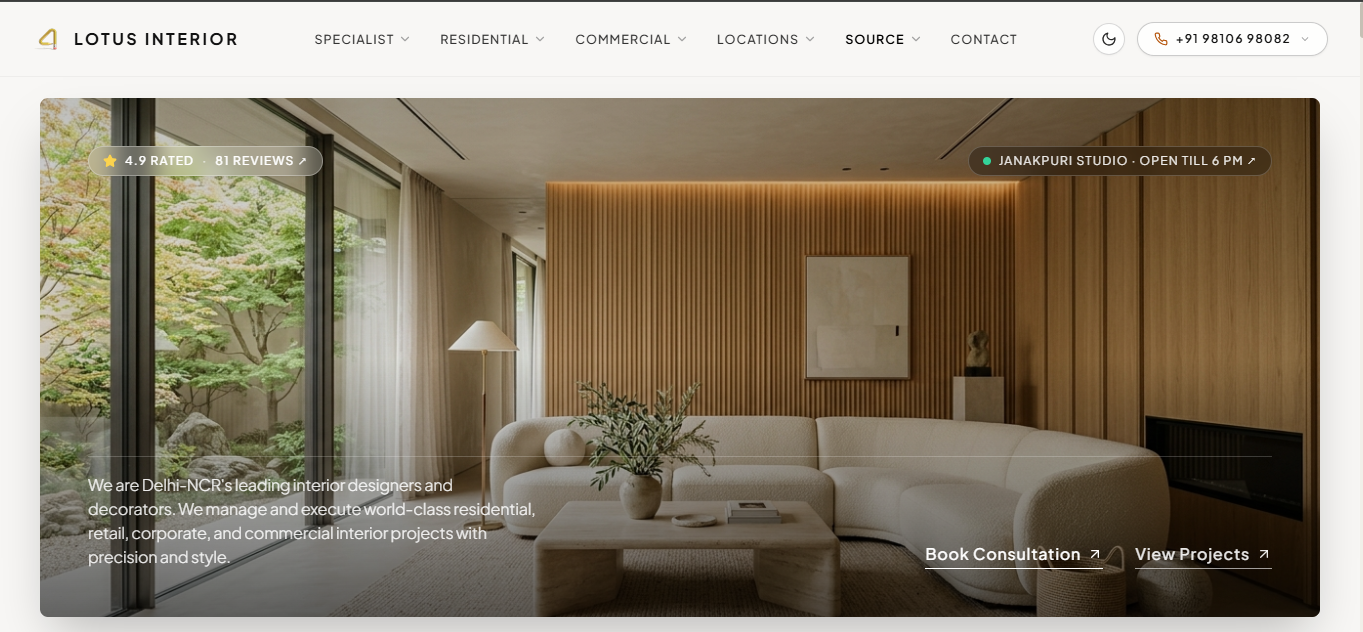
- Locally-Anchored Case Studies: Publishing authentic case studies (such as our 4 Lotus Interior work in Indore or Bandamart quick-commerce in Banda) that link geographical references to verifiable deliverables.
- Sub-0.8s Largest Contentful Paint (LCP): Google actively demotes websites whose mobile landing pages take longer than 1.5 seconds to become interactive.
The Founder's Bottom Line
You do not need a recurring monthly retainer to trick search engines. When your website is hand-crafted with clean semantic markup, fast server rendering, and structured JSON-LD, you naturally outrank competitors who are bogged down by fragile 2017 templates.
Want these exact performance metrics for your business?
Direct senior engineering sprint allocation. Zero template bloat.